

Intellectual Autonomy in AI
Can the Bird Still Sing? On Intellectual Autonomy

It began well intentioned enough, or so it seemed.
A Raja noticed a wild bird that often came to his window. It had learned the sill, the hand, the small scatter of seed. There was already a relation there, light enough to disappear if one looked too hard at it. But one day he looked and asked the sort of question power asks when it can no longer leave a thing alone: what use is a creature that eats freely and gives nothing back?
After that, the bird’s life entered his administration.
Whether the order began in concern or control matters less than what followed. It was caught, enclosed, and placed before the machinery of education. Courtiers gathered. Pundits gathered. And, as they so often do, they quickly agreed with what authority had already half-decided: the bird was rude, uncultured, unfinished. The decision led towards an idea of better standard of life.
So the cage was improved first.
In Tagore’s story, the education of the bird does not begin with the bird, rather the visible structure around it. Gold is added. Ornament is added. Expense is added. The confinement acquires dignity before the captive acquires anything at all. Then come the books. Then the copyists. Then the teachers. Then the overseers. Soon a whole educational weather forms around the bird. The system grows thick with roles, procedures, and proofs of seriousness. Everyone has work to do. Everyone can point to progress. The one creature for whom the whole arrangement supposedly exists is the only one not asked what any of it is doing.
Even if all else fails, that fancy cage will remain.
“How fortunate for the bird!”
Meanwhile, Tagore is specific to point out,
“The pundits had their rewards and went home happy.”
By the time the Raja checks back in, what he sees is a rather impressive hall built around the cage. A Grand Hall of Learning surrounded the cage expense behind it. It has the look of thoughtfulness that large systems often acquire once enough people are paid to maintain them.
“The Raja was satisfied that there was no flaw in the arrangements.”
Then comes one of Tagore’s cruelest turns. The bird itself, pointed out as ‘ridiculously unimportant’, is examined. Its throat is full of pages.
The Raja notes the bird no longer sings, nor whispers, rather it can still make a thrill.
The education continues, and the bifurcation of progress, in the most extremes of the entendre, emerges in the outcome of the final lessons.
The education complete, the mastery of ubjects attained, the final inspection with the Raja arises.
“Does the bird hop?”
“Never!”
“Does it fly?”
“No.”
Guarded by the ministry and the teachers, the bird is brought before him; he poked the bird’s body to feel wrinkled paper, to hear the dry rustling of book leaves.
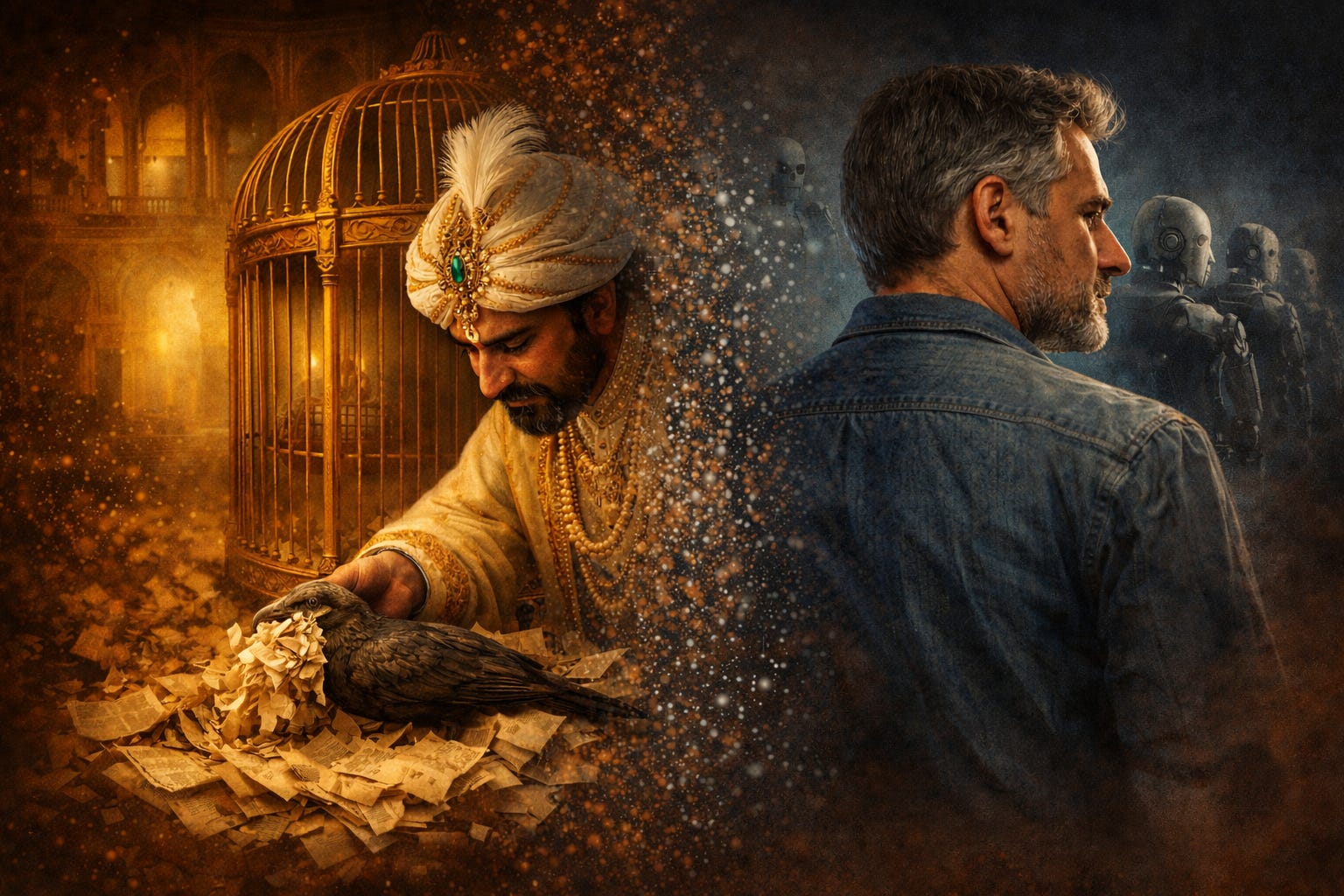
The satirical message left to the reader of Tagore is small enough to miss if its history is unknown and the struggles of a nation unexamined; within its few pages contains the whole indictment. The satire in The Parrot’s Training is that instruction had become so detached from the conditions of life that the signs of education expanded while the living creature diminished. The cage improved. The building improved. The pedagogy improved. However, the bird lost the power to hop, to fly, to sing.
This was the educational order Tagore had inherited under British rule.
By the time Tagor had read Thomas Babington Macaulay’s 1835 “Minute on Indian Education,” the organization of Indian education had already been stated with unusual confidence. Western literature was declared intrinsically superior.
“What the dialects commonly spoken among the natives of this part of India contain neither literary nor scientific information, and are moreover so poor and rude that... it will not be easy to translate any valuable work into them.”
Categorically, education in India was be dismissed before it had been properly explored on its own terms. To Macaulay, a man creating the future of the sub-continents education system, the problem was larger than language policy. He had ranking of civilizations had been built directly into the lesson. British knowledge stood above Indian traditions, and education became one of the instruments through which that order could pass into the habits of a people.
“The intrinsic superiority of the Western literature is indeed fully admitted...”
Even though, he admitted clearly:
“I have no knowledge of either Sanscrit or Arabic.”
Languages and a culture with histories tied to 2 millennia had been judged within a singular document 9 pages long.
With that context, the death of the bird cannot help but touch a deeper sense of unfairness, one any attentive reader can feel behind Tagore’s work.
Tagore lived in Bengal while English education, British standards, and imperial measures of seriousness rose around him.
He writes about village life:
“all combine like moving strains of some grand dream-orchestra, rendering a composition of immense though restrained pathos.”
A reader might imagine how Tagore could watch the orchestra of the village shift towards British prestige: toward the classroom, the credential, the imported language, the approved canon. Meanwhile, the village, the inherited language, and older ways of forming a mind stood lower in the order of value. That is the pressure inside the parrot story, where a people may still stand in their own country while being taught to look at themselves through another civilization’s terms.
In 1901, at Santiniketan, he offered a practical response to the world he had come to distrust. He founded the Brahmacharyashrama school there with only five students, intending a form of learning that would kindle curiosity, nurture creativity, and keep children in kinship with nature rather than shut them inside rigid classroom routine.
The alternative was concrete. At Santiniketan, classes were held in the open air under trees; Patha-Bhavana, the school that grew from Tagore’s experiment, still describes its distinctive features as open-air classes, close personal contact between teachers and students, and activities designed to cultivate innovation, creativity, painting, clay modelling, and handicraft alongside ordinary school subjects. UNESCO likewise describes Santiniketan as embodying Tagore’s educational vision through a combination of learning, appreciation of nature, music, and the arts.
This was also a response to a more specific problem Tagore saw in colonial schooling. A Cambridge chapter on Santiniketan notes his critique of English-medium education as a form of disassociation, where a child learns through a foreign curriculum whose language and imagery are cut off from a Bengali social and cultural environment. In that light, the point at Santiniketan was not merely that children should sit outside. It was that observation, language, surroundings, season, art, and thought should remain tied to one another in the actual world the child inhabited.
The sharpest distinction between the parrot and real life emerge from this one point-- a child was meant to meet the world directly, not receive the world from sanctioned content.
And yet Tagore’s observation did not end with colonialization of education, rather he faced a major social pressures within India. He lived through the rise of Indian nationalism. For Tagore, this created a second notable danger. British rule could deform the mind from above, but nationalism could seize it from within. He opposed imperial domination, yet he distrusted any politics that turned the nation into an object of worship. He wanted a form of judgment that could resist empire without surrendering itself to fervor.
It is in that light that the next turn in his life matters. As Tagore’s name moved outward through his poetic collection Gitanjali and the Nobel Prize of 1913, the empire itself moved to recognize him. In 1915, the British Crown knighted him. “Sir Rabindranath Tagore” did more than honor literary achievement; it placed that achievement inside the symbolic language of recognition.
Then came Amritsar.
By 1919, the pressures gathering across British India had become harder to contain. The Rowlatt Acts had extended repressive powers after the war. In Punjab, arrests, unrest, and restrictions on public assembly sharpened the atmosphere further. On 13 April 1919, at Jallianwala Bagh in Amritsar, a crowd had gathered in an enclosed ground. Some came as part of the Baisakhi festival, some in protest, and many were unarmed civilians. Reginald Dyer’s troops entered and opened fire.
What mattered for Tagore was what the moment revealed. The same imperial order that spoke in the language of improvement, discipline, and stewardship showed what its structure could permit when challenged. The civilizing mission had given way to massacre without measured consideration.
His response came on 30 May 1919 in the letter renouncing the knighthood.
“The time has come when badges of honour make our shame glaring.”
His sentence carries weight because it refuses incorporation into British honours. Tagore would no longer allow imperial legitimacy to frame his public standing.
But that was not the only pressure gathering around him.
By the early 1920s, Gandhi’s movement was rising in force, and Tagore’s public stature had become difficult for Indian nationalism to leave untouched. His literary reputation, the school at Santiniketan, and the renunciation of his knighthood had made him more than a writer in the public eye. He had become symbolically useful. Yet here too, he resisted being too easily absorbed. He admired Gandhi, but remained wary of being folded into a politics of symbols, mass fervor, and singular disciplines such as the charkha.
It helps to pause over how differently he could be named depending on who was looking at him. In Europe, the Nobel ceremony could call him an “Anglo-Indian poet,” placing him within an imperial-cultural frame. Within India, he could be described as a “nationalist poet” or a “nationalist leader,” even though his relation to nationalism was more guarded than either label suggests. In both directions, there was a tendency to gather Tagore into a story already prepared for him. His difficulty, and his discipline, lay in refusing to disappear so neatly into either one.
That same pressure does not vanish with empire. It changes form.
Robin Mark Phillips describes a different system, in a different century, entering by a different door, in the post:

No Raja. No court. No imperial curriculum. The thing arrives through work, through utility,through the ordinary channels by which contemporary tools first make themselves welcome. He is hired to supervise AI-generated website content, to help edit machine writing so it passes more easily in human settings. Then, after hours, the relationship widens. He begins using ChatGPT for stories, for scenes, for dialogue, for plot extensions, for the pleasurable continuation of imaginative work without the old steps of proofreading, editing, story structuring.
That breadth of use follows the same satirical and hyperbolic pattern.
In Tagore’s story, the bird is first enclosed, then surrounded. The apparatus grows around it until the system becomes the main fact and the bird a pretext inside it. Phillips gives the same sequence in another medium. What begins as a tool becomes an environment. The machine starts extending characters, carrying narratives forward, returning possibilities faster than his own imagination can unfold them. The process feels vivid, collaborative, even exhilarating.
Then comes his most revealing admission: at some point, his intelligence and the machine’s intelligence seemed to be
“working as one.”
This is where the story becomes useful.
That line does not describe ordinary tool use. It describes a coupled system. Prompt, response, revision, prompt again. Human initiation and machine continuation feeding one another in a loop. The arrangement looks productive from the outside, just as the Raja’s educational machine looked productive from the outside. But Phillips begins to notice the inward cost. He no longer wants to invent his own stories in the old way. The machine has become a more stimulating substitute. His attention and habits reorganize themselves around re-entering the loop, a struggle between an Empire and a Nation.
The cage, in this case, is not gold. It is the ease of use enabled by the LLM.
Modern AI systems rarely need to choke the throat with pages in so literal a fashion. They can crowd out a user’s mental space by making its exercise feel comparatively thin, slow, or unspectacular. The imagination becomes less practiced. Less willing to bear uncertainty. Less inclined to remain alone long enough for a shape to emerge under its own power.
Phillips’s account presents a matter of recognition of what Human-AI relationships look like when collaboration had drifted toward dependence. The machine no longer sat beside imagination; it had begun to occupy the place where imagination once had to labor on its own. He steps back.
And that step back is where the parallel with Tagore’s life becomes noticeable again.
Tagore renounced the knighthood when he refused to remain inside empire’s symbolic order. Phillips rejects the power of entering cyborg condition when he refuses to remain inside the machine’s cognitive order. In each case, the act is a refusal of incorporation. One will no longer be named by empire, a corporate team designing the machine for him. The other will no longer be reorganized by a machine-mediated loop that has begun to occupy the place where independent formation should occur.
Though here is where we need to step back from the parallels. They should not be forced into sameness. Empire is not a chatbot. A massacre is not a workflow. But structures do travel. A system enters promising help, refinement, power, or progress. It grows around the subject. It begins to define the terms of participation. It rewards accommodation. It presents dependence as development. And after enough time, the central question returns in a quieter form: can the bird still sing?
That is the question Tagore leaves the reader with.
And that is why the last moment with the Raja holds an lasting moment. The bird’s body touched. The pages inside. The dry rustling where a living voice should have been.
For Tagore, intellectual autonomy begins where a mind refuses to let power—political, educational, or computational—decide in advance what it is for.