

Intellectual Responsibility
From Soviet Genetics to LLM Memory: The Discipline of Intellectual Responsibility

His brilliance could be found in his stubbornness.
His folly could also be found in his stubbornness.
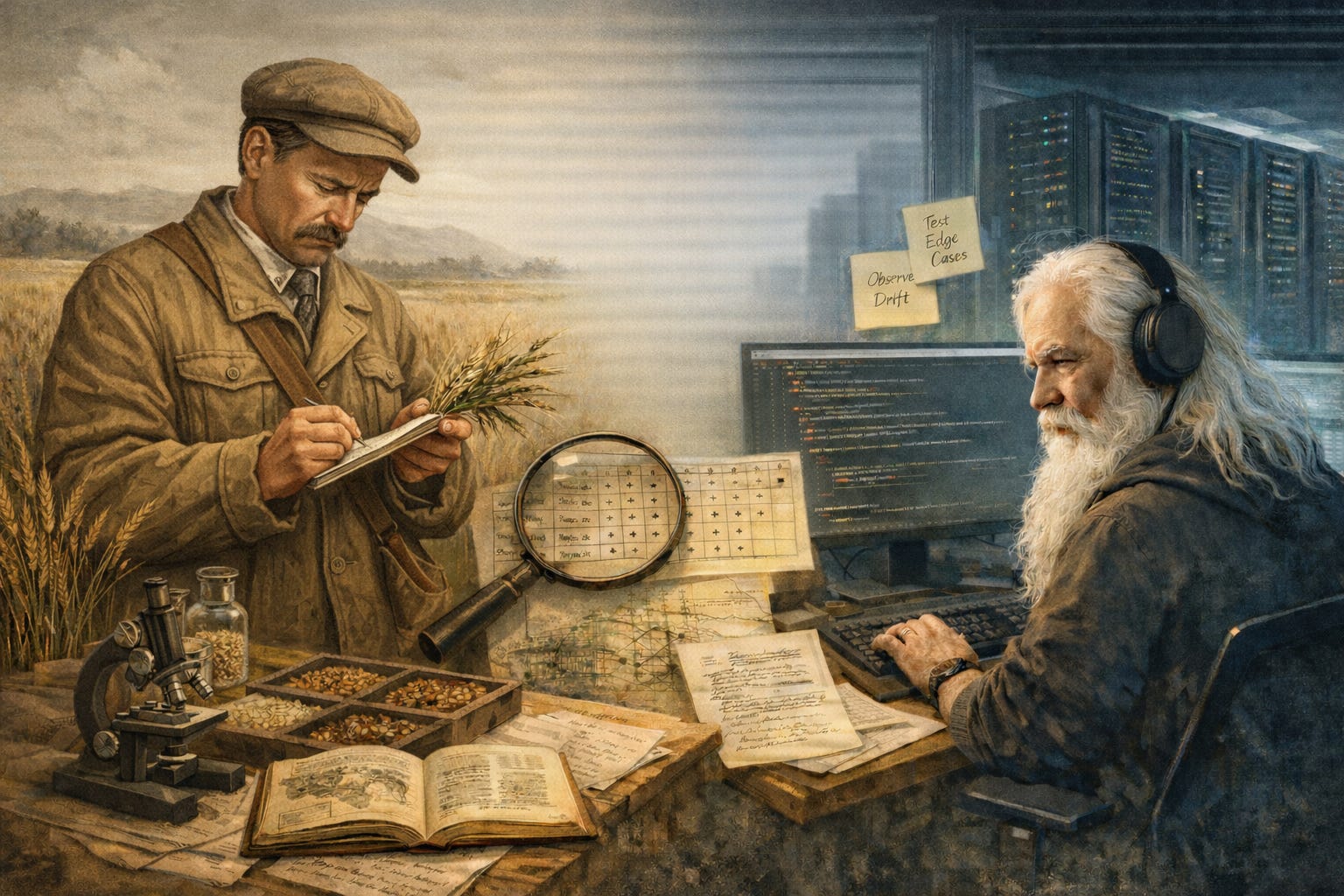
Nikolai Vavilov’s brilliance is easy to see in the writings he left behind: the way his work allows a reader reconstruct his observations, piece by piece, through the discipline of his method. In The Centers of Origin of Cultivated Plants, there is a table with rows of common flower characteristics and columns spanning different plant species—crops, weeds, and related forms—each cell marked with a plus and dash. It runs across pages, and even to a layman’s eye, the meticulousness of the observation is unmistakable. Having studied flowers from species across continents, the same binary method appears again and again in Nikolai’s continued search through evolution. The same habit of comparison appears again and again, as though one is watching a mind return to the same instrument because it has earned his trust.
As one reads further, his work goes beyond simple observation and into the practices of farming. Across the table—and across the chapters—he compares species and varieties, tracks where traits concentrate, and distinguishes forms identified as wild, crop, and weedy. Among these comparisons, hints begin to surface: rye hidden among wheat and barley, and oats in emmer fields. In the 1920s, both rye and oats could still be treated as weeds in many places, yet both appeared abundantly embedded within the cash crop. It was as if the crop fields quietly recorded a longer history than human categories used to describe it.
Nikolai’s brilliance emerged when he recognized what the plusses and dashes implied, that the same selection practices used by farmers were shaping what survived. Under repeated cycles of weeding, harvesting, threshing, and seed cleaning, the seeds that remained increasingly resembled the crop stream itself: rye among wheat and barley, oats among emmer. Over generations of human sifting, the weed seeds became difficult to distinguish both by tool and the trained human eye.
It was evidence towards something larger, that humans were directly shaping the evolution of plants on a global scale. Nikolai’s later work showed the same level of care and caution, and for that reason his conclusions gained force rather than losing it. His method strengthened through public challenge.
In 1982, Georges Pasteur gave this class of observation a name—Vavilovian mimicry—nearly forty years after the chain of events that led to Nikolai’s death.
However, before getting into this, the state of Russian botanical science in the 1920s has to be recognized. By the 1920s, Mendelian genetics had established a powerful methodological framework for heredity research. This was the methodological lineage Nikolai worked within. Later in the 1920s, Vavilov was already an established scientist with major contributions behind him, including the law of homologous series and his developing work on centers of origin.
Meanwhile, another Soviet scientist appeared in the public eye through a very different route. In a 1927 Pravda article, Trofim Lysenko presented a new method for improving wheat seed germination. He was not merely noticed; he was celebrated, even hailed as a “wizard.”
So here they were: Lysenko was newly emerging in Soviet media just as Vavilov was already a leading scientific figure. But fame did not place them on the same path. It brought them into the same field from different motivations, and under very different rules of survival. Nikolai remained anchored to Mendelian processes and method. Trofim moved toward a political, and increasingly fanciful, revolt against the established scientific order. While Vavilov’s work was building large-scale evidence across continents through meticulous comparison and rigor, Trofim stood firm in arguing that environmental factors alone could alter plant heredity.
And this was not happening in a vacuum.
After the Great Break—the radical shift in Soviet economic policy beginning in 1928–1929—science, too, felt the force that had already passed through the rest of the country. Soviet authorities distrusted scientists: first, because they were intellectuals and not workers; second, because they adhered to scientific principles rather than Party principles. The Bolshevik leadership wanted a new science built by new people on new principles—science subordinate to ideology, not an independently minded scientific community. To produce this, every instrument was used: the promotion of Party-aligned institutions, the organization of scientists into structures for “building socialism,” the removal of prominent “traditional” scientists from public and scientific life, and the attempted “reformation” of those who remained—a process framed in the USSR as reforging.
Trofim Lysenko arrived at exactly the right moment for that project. His peasant origins aligned him socially with the authorities, while the intelligentsia remained suspect. He promised quick agricultural victories where “traditional” scientists warned of limits and timelines. He repeated, in speech after speech, the Party language of class struggle in science, of enemies and saboteurs. He also supported Lamarckian ideas of heredity and evolution, ideas that resonated with Stalin’s belief that nature, society, and even human beings could be forcefully remade.
This is how Lysenkoism rose to dominance in Soviet biology.
It presented itself as science—indeed, as the only true science—but it was, at root, a social and political phenomenon wearing scientific authority. It is often remembered as an assault on genetics, but in practice it spread much wider, covering biology more broadly under the banner of “Michurinist biology.” Its rise accelerated in the mid-1930s, and its period of official dominance over classical genetics is most clearly associated with 1948 to the mid-1960s.
That rise was especially destructive because Soviet genetics had not been backward. It had reached world-class levels by the mid-1930s through the work of major scientific schools led by figures such as Sergei Navashin, Nikolai Koltsov, Grigorii Levitsky, Yuri Filipchenko, Nikolai Vavilov, and Solomon Levit. The tragedy was not scientific weakness. It was that the state distrusted intellectually independent science and instead elevated a fraudulent pseudoscientific program—Lysenkoism—which gravely damaged biology as a whole.
At its most extreme, Lysenkoist claims crossed from error into absurdity: not only the inheritance of acquired traits in the crude Lamarckian sense, but assertions of species “transformation” under environmental pressure on an ontogenetic timescale—wheat yielding rye grains, or even fantastical claims of one species producing another under altered conditions.
Which brings the story back to the humble rye grain.
Because if the disagreement between Nikolai and Trofim is to be understood—not just scientifically, but politically—then rye is a good place to stand. In that grain, the methodological conflict becomes visible. And in the way each man handled it, the cultural environment of the USSR can be seen shaping not only scientific claims, but scientific outcomes.
Picture Nikolai first, in the field, where the work begins not with theory but with collection. He moves through standing crops and takes samples slowly, methodically—small handfuls at a time, many samples across a field, then across regions. Wheat, barley, oats, rye. In the field they are gathered together by practice and proximity; only later, under cataloging, do their differences separate cleanly. Rye matters here precisely because it can hide in plain sight—appearing among cultivated cereals as weed, companion, intruder, or remnant of older agricultural histories.
In the lab, the grains look similar at a glance, then less so under attention. He turns them into evidence. He logs: Where was this collected? In what field? Mixed with what crop? Was it appearing as cultivated, weedy, or transitional in form? Then the harder questions begin: what is stable, what is changing, and what only appears to be changing because the eye wants a pattern too soon? Rye, in this setting, is not a symbol. It is a problem of placement, lineage, and long selection under human cultivation. There is patience in this kind of work, but also discipline. The excitement, if it comes, comes later—after comparison, after repetition, after the tables fill with relations hidden to the ordinary glance. Across continents he repeated the same process, giving years of his life to evidence before declaration.
Now place that same rye grain in Trofim’s political weather.
In another part of the Soviet Union stands Trofim, first presenting work on seed treatment and germination under controlled conditions. His early rise came through jarovization (vernalization): exposing seeds to cold and moisture so winter cereals could be induced to behave differently in planting schedules, a line of work publicized as practically transformative for Soviet agriculture. Contemporary and later historians note that these early claims drew attention because they promised immediate agricultural utility, even as his research methods were weakly controlled and poorly validated by standard statistical practice.
Then the country changed around him. Institutions shifted, “traditional” scientists came under suspicion, and usefulness to Party objectives became a form of protection and advancement. In that setting, grain was no longer only a biological object. It was yield, urgency, proof of ideological competence. This is where rye enters the story differently for Lysenko. Instead of remaining a stubborn classification problem, rye could be pushed into a doctrine of transformation. In Lysenkoist doctrine and propaganda, claims expanded beyond vernalization into species-transformation assertions (including grain-to-grain “transformations”) presented as environmentally induced heredity. In that political environment, claims about grain could function as ideological proof as much as biological evidence. Wheat can produce rye, and rye wheat.
And this is why the rye seed matters before ever arriving at the work of Jinx, an independent researcher exploring the nature of identity and continuity in LLMs. In one setting, his seed can remain a stubborn object—something to be collected, compared, and handled with care until it yields a pattern slowly. In another, the same seed can be pulled upward into urgency, doctrine, and perceived public usefulness before the method has finished speaking.

That older Lysenko-Vavilov conflict does not return in identical form, rather its structure seems to. The objects change: farmer fields become interfaces, seed streams become context windows and memory traces, and the laboratory is now partly hidden behind Github, data centers, GPUs, and a laptop. Yet the pressure feels familiar. Jinx’s work begins to matter at exactly this point, because he keeps returning to the same Vavilovian responsibility: to stay with the object long enough to describe what is happening before the surrounding institutions, incentives, and narratives decide what the thing is allowed to mean or absorb his small yet growing project, Augustus into their own uses.
Since last October, he appears to have been working a single question, How does memory structure determine the stability of an AI’s emergent personality across sessions? Around that question, one can see the ordinary signs of serious inquiry—debates with other engineers, pressure-testing assumptions with researchers, and the slow sharpening of terms before claims are made too quickly.
By January 21, he began formalizing the idea of a ‘context lattice’, framing stability of a form of memory to preserve memory across sessions and devices:
When you’re deep in a problem with an LLM, a kind of reasoning scaffold accumulates in the context.
The phrasing is telling; it is the kind of observation that sounds obvious only after someone has taken the trouble to name it.
In the writing that follows, the reader begins to recognize a certain pattern of mind—not because the subject matter resembles Vavilov’s, but because the posture does. Jinx shares testable hypotheses rather than a finished doctrine.
“Richer context returns a richer result.”
It should be possible to identify the points where transformation occurs and tied to states.
All of the answers to these questions can be completed in a familiar to current methods.
The answers, he suggests, may be reachable with methods already familiar to current practice.
He then moves on to explain his planned approach and its implications:
Jinx is careful to state an important fact about his method: this is not a formal study, but an exploration of a question—a project bounded, as most scientifically serious projects are, by time, access, and resources. It reveals his method. His inquiry is being carried honestly within its constraints.
A major observation sits here, and it helps clarify the earlier contrast between Nikolai and Trofim under constraint. Resource limits do not only restrict research; they also shape what kinds of choices become available. Nikolai responded by extending the search outward—raising support, building networks, persuading others to fund the work so the method could continue on its own terms. Trofim, having established credibility, moved in a different direction: his earlier work became increasingly useful to the political agenda of the USSR. It is not hard to imagine that the beginning felt professionally legitimate enough—an investigator testing assumptions, pursuing practical gains, and finding that some results appeared to scale. But somewhere along that path, usually invisible at the start, the practical need and the state’s need ceased to be separate. The search may have begun as inquiry. What followed was something else.
In late January, Jinx shares an exploration into Claude’s memory, testing the edges of his Context Lattice idea to see whether it held up as more than an intuition. Was it real? What he found, at least provisionally, supported his first hypothesis: performance and creative leaps appeared to depend on the richness of the conversation itself. That, in turn, reinforced a larger claim—that interaction history has a signal and a structure. It supports the idea that richer memory organization may matter for AI stability, continuity, or what users experience as personality. The question does not close. It opens further.
In early February, Jinx writes ‘An Open Letter To Anthropic From LLM Users”. The reader notices the argument opening broadly, then narrowing with intent, and that turn comes directly from his own exploration. Across time, devices, and even careers, he points to a single email service that became a durable constant in ordinary life. From there, he makes a larger inference: collaboration with an LLM is likely to follow the same pattern of product dependence. And he writes as if he can already see the outline of it—the lattice beginning to circle inside Claude’s design.
Working from user improvisations and workarounds, Jinx begins to focus on memory stability with something close to a human-factors sensibility. Memory, he suggests, is often already embedded in the environment if one knows where to look. And it is here that the deeper point appears: real memory does not sit neatly in one place. It is distributed across transcripts, prompts, saved files, handoff notes, search traces, and recurring interaction habits. This is the Context Lattice in practical form—what, in non-virtual terms, would be recognized as distributed cognition. Within LLM platforms, that structure is scattered, partial, and easy to overlook, yet it still functions as a knowledge architecture. His argument is that it should be treated as such, and eventually internalized into the design rather than left to survive as user improvisation.
In mid-February, he began work to centralize this key observation. Jinx moves from theory into a working arrangement, showing how continuity can be built rather than merely hoped for: Claude Desktop becomes the interactive “brain,” Augustus the autonomous “body,” and between them he establishes a repeating loop of session history, searchable transcripts, written observations, and next-session guidance. What emerges is less a single agent than a coordinated memory practice.
The post is practical on the surface—installation steps, MCP configuration, model and basin settings, observation prompts—but the deeper point is the same one running through his larger work: identity stability does not come from one clever run, it comes from structured memory and disciplined return. He also reports a failure state with unusual clarity: left to introspection alone, the system begins to decay into self-reference. Recovery comes only when it is reattached to the outside world—web search, real projects, external material, something stubborn enough to resist the loop. The lesson lands softly but firmly: sessions do not stay alive on procedure alone; they need contact, trajectory, and a memory structure capable of carrying the work forward.
Jinx, at least in the Augustus phase of the work, appears to be following Nikolai: keeping inquiry faithful to the object while the field around it is already being organized by larger forces. Even when he is openly combative with the major firms over his project, the underlying posture reads less as self-promotion than as a defense of the inquiry itself—a form of intellectual responsibility to the method, to the evidence, and to what the object is doing before institutions decide what it should mean for the larger community.
The older contrast remains useful as a way of keeping certain pathes in view—the one that opens in public-facing research when attention, usefulness, and institutional gravity begin to gather around the work. This is not a prediction about Jinx’ future path. Rather, it is simply part of the terrain. In LLM research especially, where the research is unstable, the incentives can be immeasurably immediate, and the surrounding narratives form quickly, the pressure to move from observation to explanation, and from explanation to doctrine, is never far away. The comparison helps for that reason alone: it keeps the burden of intellectual responsibility towards others and the work visible, so that stubbornness remains a discipline of staying and growing with the work, rather than a habit of defending what the work once seemed to say.